

Summer Schools and Workshops
The Materials Computation Center holds annual Summer Schools on current topics in computational materials science, which typically generate about 30 hours of lecture videos and 1,000 pages of lecture notes. Many of the summer school teaching materials and computer labs are available for download from the Schools' websites, listed below.
The Center also participates in workshops, symposia, and meetings by providing funding, through organizing and hosting, and by providing instruction and lecture materials. Currently, the MCC sponsors the yearly "Understanding Complexity Symposium" and the "Recent Developments in Electronic Structure Methods", a roaming workshop initiated by UIUC.
Summer Schools on Computational Materials Science
Downloadable summer school teaching materials and computer labs are listed below.
- 2016 Quantum Monte Carlo Training Program June 5-10, 2016 at NCSA (2016)
- Quantum Monte Carlo Training Program July 14-18, 2014 at Argonne National Laboratory (2014)
- Quantum Monte Carlo Applications and Methods (2012)
- 2010 Tutorial on Electronic-Structure Calculations for Spintronic-related Materials (2010)
- 2010 Nano-Biophotonics Summer School (2010)
- 2009 Nano-Biophotonics Summer School Lectures (2009)
- 2009 Nano-Biophotonics Summer School (2009)
- Recent Developments in Electronic Structure Methods (2008)
- Quantum Monte Carlo from Minerals and Materials to Molecules (2007)
- Multiscale Theory, Simulation, and Reality at the Nano-Bio Interface (2007)
- Ab Initio Molecular Dynamics Simulation Methods in Chemistry (2006)
- Hands-on introduction to Electronic Structure and Thermodynamics Calculations of Real Materials (2005)
- Introduction to Computational Nanotechnology (2004)
- Theoretical and Computational Biology (2003)
- Computational Approaches for Simulation of Electron Devices and MEMS (2002)
- Tools for multiple length and time scales (2001)
Annual Workshops
Recent Developments in Electronic Structure Methods
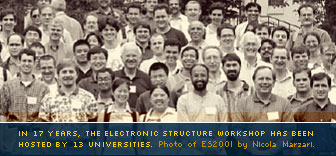
 The annual Workshop on Recent Developments in Electronic Structure Methods connects active participants in electronic structure theory from universities, colleges, government labs, and industrial labs from around the world. The invited presentations and contributed posters describe new methods for computing previously inaccessible properties, breakthroughs in computational efficiency and accuracy, and novel applications of these approaches to the study of molecules, liquids, and solids. This workshop was started by David M. Ceperley and Richard M. Martin (Physics, UIUC) in 1989. In 19 years, this workshop has been hosted by 13 universities including:
- The Ohio State University
- Cornell University
- Georgia Institute of Technology
- University of California at Santa Barbara
- St. Mary’s College of Maryland, and
- North Carolina State University.
Each year, MCC provides seed money for the Electronic Structure Methods workshop. This funding enables wider local student participation and helps organizers gain additional support. The workshop is funded by both local organizations and by the National Science Foundation, Materials World Network: The Materials Computation Center Outreach Effort Award #1107472.
The MCC hosted the 2008 Recent Developments in Electronic Structure Methods workshop, June 18-20, 2008.
The Understanding Complex Systems Symposium

The Understanding Complex Systems Symposium (UCS) brings together researchers from many academic disciplines and industry to stimulate cross-disciplinary research activities involving complex systems. Originated by Alfred Hübler (Physics, UIUC) in 2001, this event has grown yearly. The training of the speakers is rather diverse: Physics and Material Science, Engineering, Computer Science, Cognitive Science, Genetics and Biology, Math, Bioinformatics Physiology, Management, Medical Science, and Social Science.
Over four days, UCS 2005 had 300 researchers, including two Nobel Laureates, and 150 graduate students, who gave 122 talks. The speakers came from diverse backgrounds: 3-6 speakers are Hispanic, one plenary speaker is African-American, one plenary speaker is an American-Indian woman, and there were over a dozen other female speakers. International speakers came from Armenia, Bulgaria, Canada, Germany, Israel, Italy, Japan, and the United Kingdom.
2010 World-University-Network (WUN) International Conference on Spintronic Materials and Technology
Held at the Beckman Institute at the the University of Illinois (June 21-23, 2010). The 3rd WUN International Conference on “Spintronic Materials and Technology” (WUN-SPIN10) is a follow-up of the 1st (WUN-SPIN07, York, UK 2007) and the 2nd (WUN-SPIN08, Nanjing & Hangzhou 2008) conferences. This conference is intended to be a forum for experts to discuss the new scientific and technological developments in the field of spintronics.
Local organizers: Jean-Pierre Leburton and Duane Johnson.
Other Workshops and NSF Meetings
With support from the Frederick Seitz Materials Research Laboratory and the National Center for Supercomputing Applications, the MCC organizes meetings and reviews on behalf of the National Science Foundation. Through wide-scale participation, these events provide a unique, valuable snapshot of current research. The MCC also provides web support for other NSF-supported events.
2006 NSF Cyberinfrastructure in Materials Research Town Hall Meeting

August 3, 2006 Meeting Description: This meeting brought together leading researchers in Materials Science, including experts in the application of cyberinfrastructure to materials research. It also included some experts from other scientific domains who have pioneered the use of cyberinfrastructure in their research. These experts represented areas where we project that cyberinfrastructure issues will impact materials research in the upcoming years, such as the creation and exploitation of databases and the curation and analysis of very large datasets.
2005 NSF High Performance Computing Town Hall Meeting

October 17, 2005 Meeting Description: To break down barriers to communication, this meeting will occur in the cyber world and the real world. There will be a virtual forum for the group to help facilitate discussions leading to a report to NSF. The meeting will take place on October 17, 2005 and will be hosted by the Materials Computation Center, on the University of Illinois campus, with participation of access grid nodes across the country. The meeting will report progress on the main questions a bove and identify candidate benchmarks to measure the performance of high performance computers at the "production machine" level and those at the "petascale" level. A follow-up meeting, date to be determined, will crystallize the view of the community on this aspect of high performance computing.
2004 NSF Division of Materials Research ITR Computational Workshop

June 17-19, 2004 Meeting Description: The first two days of the workshop will highlight the exciting science supported by current NSF Information Technology Research grants managed by the Materials Theory program in the Division of Mater ials Research. The Thursday/Friday presentations will be of interest to PIs, postdocs, and students. The third day of the workshop will be devoted to discussing and identifying cyberinfrastructure needs to support the scientific aspirations (the "cyberscience") of the materials theory community. The Saturday presentations will be of interest pr imarily to the PIs, co-PIs, and postdocs; student attendance is not required. The workshop will end around 1pm.
2002 NSF Division of Materials Research ITR Computational Workshop

June 19-20, 2002 Meeting Description: The NSF-DMR, and Materials Theory in particular, has invested significant resources in computational materials research over the past decade. DMR and Materials Theory will conduct a review of research supporte d under various computational initiatives (HPCC/CARM, KDI, ITR), as well as larger projects such as Focussed Research Groups and NIRT's with a computational focus. As it is virtually impossible to visit all of the groups, the main goal is to have a concer ted review of all groups simulaneously, especially to encourage cross-talk among grantees; to provide an opportunity for young investigators to present their research; and, to provide the computational community with an overview of opportunities available in computational sciences at NSF, especially through ITR.
Index of Summer Schools Videos and Lectures
Records Returned: 280
| Date Presented | Instructor | Type | Title |
|---|---|---|---|
| 2005-06-13 | Richard Martin, University of Illinois | Talk |
Overview of Electronic Structure (pdf) Part of: Overview of Electronic Structure theory and methods including Density Functional Theory
|
| 2005-06-13 | Richard Martin, University of Illinois | Talk |
Density Functional Theory; Kohn-Sham equations (pdf) Part of: Overview of Electronic Structure theory and methods including Density Functional Theory
|
| 2005-06-13 | Richard Martin, University of Illinois | Talk |
Electron Bands (pdf) Part of: Overview of Electronic Structure theory and methods including Density Functional Theory
|
| 2005-06-13 | Richard Martin, University of Illinois | Talk |
Bands (pdf) Part of: Overview of Electronic Structure theory and methods including Density Functional Theory
|
| 2005-06-13 | Richard Martin, University of Illinois | Talk |
Pseudopotentials � Band structures (pdf) Part of: Overview of Electronic Structure theory and methods including Density Functional Theory
|
| 2005-06-14 | Donald R. Hamann, Bell Labs and Rutgers | Talk |
Learning ABINIT (pdf) Part of: Hands-on introduction to the plane wave pseudopotential code ABINIT using the ABINIT
|
| 2005-06-14 | Donald R. Hamann, Bell Labs and Rutgers | Talk |
Abinit response-function capabilities (pdf) Part of: Hands-on introduction to the plane wave pseudopotential code ABINIT using the ABINIT
|
| 2005-06-14 | Donald R. Hamann, Bell Labs and Rutgers | Talk |
Abinit response-function capabilities -- Figures (pdf) Part of: Hands-on introduction to the plane wave pseudopotential code ABINIT using the ABINIT
|
| 2005-06-14 | Donald R. Hamann, Bell Labs and Rutgers | Talk |
Final Exam for Participants of the Summer School (pdf) Part of: Hands-on introduction to the plane wave pseudopotential code ABINIT using the ABINIT
|
| 2005-06-15 | J. Miguel Alonso-Pruneda, Instituto de Ciencia de Materiales | Talk |
Introduction to the SIESTA method (pdf) Part of: Hands-on introduction to the local orbital pseudopotential code SIESTA for electronic structure calculations and ab initio molecular dynamics simulations of molecules and solids
|
| 2005-06-15 | J. Miguel Alonso-Pruneda, Instituto de Ciencia de Materiales | Talk |
Introduction to the SIESTA method (ppt) Part of: Hands-on introduction to the local orbital pseudopotential code SIESTA for electronic structure calculations and ab initio molecular dynamics simulations of molecules and solids
|
| 2005-06-15 | J. Miguel Alonso-Pruneda, Instituto de Ciencia de Materiales | Talk |
Pseudopotential and basis generation | (pdf) Part of: Hands-on introduction to the local orbital pseudopotential code SIESTA for electronic structure calculations and ab initio molecular dynamics simulations of molecules and solids
|
| 2005-06-15 | J. Miguel Alonso-Pruneda, Instituto de Ciencia de Materiales | Talk |
Pseudopotential and basis generation | (ppt) Part of: Hands-on introduction to the local orbital pseudopotential code SIESTA for electronic structure calculations and ab initio molecular dynamics simulations of molecules and solids
|
| 2005-06-15 | J. Miguel Alonso-Pruneda, Instituto de Ciencia de Materiales | Talk |
How to run SIESTA (pdf) Part of: Hands-on introduction to the local orbital pseudopotential code SIESTA for electronic structure calculations and ab initio molecular dynamics simulations of molecules and solids
|
| 2005-06-15 | J. Miguel Alonso-Pruneda, Instituto de Ciencia de Materiales | Talk |
How to run SIESTA (ppt) Part of: Hands-on introduction to the local orbital pseudopotential code SIESTA for electronic structure calculations and ab initio molecular dynamics simulations of molecules and solids
|
| 2005-06-15 | J. Miguel Alonso-Pruneda, Instituto de Ciencia de Materiales | Lecture |
Sistematics (pdf) Part of: Hands-on introduction to the local orbital pseudopotential code SIESTA for electronic structure calculations and ab initio molecular dynamics simulations of molecules and solids
|
| 2005-06-15 | J. Miguel Alonso-Pruneda, Instituto de Ciencia de Materiales | Lecture |
Sistematics (pdf) Part of: Hands-on introduction to the local orbital pseudopotential code SIESTA for electronic structure calculations and ab initio molecular dynamics simulations of molecules and solids
|
| 2005-06-15 | J. Miguel Alonso-Pruneda, Instituto de Ciencia de Materiales | Computer_lab |
SIESTA (tar) Part of: Hands-on introduction to the local orbital pseudopotential code SIESTA for electronic structure calculations and ab initio molecular dynamics simulations of molecules and solids
|
| 2005-06-18 | Duane D. Johnson, University of Illinois at Urbana-Champaign | Lecture |
Electronic Structure Effects and Energies of Alloy Transformations (pdf) Part of: Alloy Electronic Structure, Structural Formation Energies, and Preliminaries of Cluster Expansion Hamiltonians and Improving Accuracy of Thermodynamics predicted from Multi-scale methods by Global Data integration
|
| 2005-06-18 | Duane D. Johnson, University of Illinois at Urbana-Champaign | Lecture |
Basics of Cluster Expansions and Getting a Optimal Cluster Expansion (pdf) Part of: Alloy Electronic Structure, Structural Formation Energies, and Preliminaries of Cluster Expansion Hamiltonians and Improving Accuracy of Thermodynamics predicted from Multi-scale methods by Global Data integration
|
| 2005-06-18 | N. Zarkevich, University of Illinois at Urbana-Champaign | Lecture |
Improving Accuracy of Thermodynamics predicted from Multi-scale methods by Global Data integration (pdf) Part of: Alloy Electronic Structure, Structural Formation Energies, and Preliminaries of Cluster Expansion Hamiltonians and Improving Accuracy of Thermodynamics predicted from Multi-scale methods by Global Data integration
|
| 2005-06-18 | Duane D. Johnson, N. Zarkevich, University of Illinois at Urbana-Champaign | Computer_lab |
Computer Lab (zip) Part of: Alloy Electronic Structure, Structural Formation Energies, and Preliminaries of Cluster Expansion Hamiltonians and Improving Accuracy of Thermodynamics predicted from Multi-scale methods by Global Data integration
|
| 2005-06-19 | Gus Hart, Northern Arizona University | Computer_lab |
Cluster Expansions: Treating the effects of strain (gz) Part of: Constructing Cluster Expansions for Size-Mismatched Systems and Genetic Algorithm Strategy for Cluster Expansions
|
| 2005-06-19 | Gus Hart, Northern Arizona University | Lecture |
Cluster Expansions: Treating the effects of strain (pdf) Part of: Constructing Cluster Expansions for Size-Mismatched Systems and Genetic Algorithm Strategy for Cluster Expansions
|
| 2005-06-19 | Gus Hart, Northern Arizona University | Lecture |
Building Model Hamiltonians via an Evolutionary Approach (pdf) Part of: Constructing Cluster Expansions for Size-Mismatched Systems and Genetic Algorithm Strategy for Cluster Expansions
|
| 2005-06-20 | Axel van der Walle, Northwestern University | Lecture |
ATAT Overview (pdf) Part of: ATAT - A software toolkit for modeling coupled configurational and vibrational disorder in alloy systems
|
| 2005-06-20 | Axel van der Walle, Northwestern University | Computer_lab |
ATAT Computer Lab (zip) Part of: ATAT - A software toolkit for modeling coupled configurational and vibrational disorder in alloy systems
|
| 2005-06-21 | Dane Morgan, University of Wisconsin | Lecture |
Thermodynamics, Phase Diagrams, and the Cluster Expansion (pdf) Part of: Thermodynamics, Phase Diagrams, and the Cluster Expansion
|
| 2005-06-21 | Dane Morgan, University of Wisconsin | Computer_lab |
Thermodynamics, Phase Diagrams, and the Cluster Expansion (zip) Part of: Thermodynamics, Phase Diagrams, and the Cluster Expansion
|
| 2005-06-22 | Anton van der Ven, University of Michigan | Lecture |
Diffusion (pdf) Part of: Diffusion in Alloys via the Cluster Expansion
|
| 2005-06-22 | Anton van der Ven, University of Michigan | Lecture |
Kinetic (pdf) Part of: Diffusion in Alloys via the Cluster Expansion
|
| 2006-08-01 | Stefano Baroni, Sissa Trieste and DEMOCRITOS | Lecture |
Density-functional pertubation theory (pdf) Part of: General introduction to total energy and forces in DFT, and path finding methods
|
| 2006-08-01 | Stefano Baroni, Sissa Trieste and DEMOCRITOS | Lecture |
Computer simulation of thermally activated processes (pdf) Part of: General introduction to total energy and forces in DFT, and path finding methods
|
| 2006-08-01 | Stefano Baroni, Sissa Trieste and DEMOCRITOS | Lecture |
Molecular structure and dynamics with DFT (pdf) Part of: General introduction to total energy and forces in DFT, and path finding methods
|
| 2006-08-05 | Guido Fratesi,University of Milan | Lecture |
PWSCF First Examples [pdf] (pdf) Part of: Density-functional perturbation theory
|
| 2006-08-05 | Guido Fratesi,University of Milan | Lecture |
Rare Events [pdf] (pdf) Part of: Density-functional perturbation theory
|
| 2006-08-05 | Guido Fratesi,University of Milan | Lecture |
Structural Optimization [pdf] (pdf) Part of: Density-functional perturbation theory
|
| 2006-08-06 | Nicola Marzari, MIT; Paolo Giannozzi, Scuola Normale Superiore and DEMOCRITOS; Axel Kohlmeyer,University of Pennsylvania | Lecture |
Ab Initio Molecular Dynamics: Part One (pdf) Part of: Car-Parrinello and Born-Oppenheimer molecular dynamics
|
| 2006-08-06 | Nicola Marzari, MIT; Paolo Giannozzi, Scuola Normale Superiore and DEMOCRITOS; Axel Kohlmeyer,University of Pennsylvania | Lecture |
Ab Initio Molecular Dynamics: Part Two (pdf) Part of: Car-Parrinello and Born-Oppenheimer molecular dynamics
|
| 2006-08-07 | Brett Bode, Iowa State University | Lecture |
GAMESS and MACMOLPLT (pdf) Part of: Quantum Chemistry with GAMESS
|
| 2006-08-07 | Brett Bode, Iowa State University | Lecture |
Lab: Quantum Chemistry with GAMESS (pdf) Part of: Quantum Chemistry with GAMESS
|
| 2006-08-07 | Brett Bode, Iowa State University | Lecture |
Lab: README.MacMolPlt (txt) Part of: Quantum Chemistry with GAMESS
|
| 2006-08-07 | Thom Dunning, UIUC | Lecture |
Using Basis Sets to Solve the Electronic Schrodinger Equation with Electron Correlation (pdf) Part of: Convergence in Electronic Structure Methods
|
| 2006-08-07 | Thom Dunning, UIUC | Lecture |
Using Basis Sets to Solve the Hartree-Fock-Equations (pdf) Part of: Convergence in Electronic Structure Methods
|
| 2006-08-07 | Thom Dunning, UIUC | Lecture |
Exercise: Systematic Improvement of Basic Sets (pdf) Part of: Convergence in Electronic Structure Methods
|
| 2006-08-08 | Lubos Mitas North Carolina State University | Lecture |
Quantum Monte Carlo Methods (pdf) Part of: Fundamentals of Quantum Monte Carlo
|
| 2006-08-08 | Lubos Mitas North Carolina State University | Lecture |
Quantum Monte Carlo Methods: recent developments and applications (pdf) Part of: Fundamentals of Quantum Monte Carlo
|
| 2006-08-08 | Marcus Elstner, University of Heidelberg | Lecture |
Approximate methods for large molecular systems (ppt) Part of: Theory, Performance and Applications of DFTB
|
| 2006-08-08 | Marcus Elstner, University of Heidelberg | Lecture |
DFT and VdV interactions (ppt) Part of: Theory, Performance and Applications of DFTB
|
| 2006-08-08 | Marcus Elstner, University of Heidelberg | Lecture |
Introduction into DFTB: Part 3 of 3 (pdf) Part of: Theory, Performance and Applications of DFTB
|
| 2006-08-08 | Marcus Elstner, University of Heidelberg | Lecture |
Introduction into DFTB: Part 1 of 3 (pdf) Part of: Theory, Performance and Applications of DFTB
|
| 2006-08-08 | Marcus Elstner, University of Heidelberg | Lecture |
Introduction into DFTB: Part 2 of 3 (pdf) Part of: Theory, Performance and Applications of DFTB
|
| 2006-08-08 | Marcus Elstner, University of Heidelberg | Lecture |
QM/MM Calculations and Applications to Biophysics (ppt) Part of: Theory, Performance and Applications of DFTB
|
| 2006-08-08 | Lubos Mitas North Carolina State University | Lecture |
Quantum Monte Carlo lab notes (ppt) Part of: Fundamentals of Quantum Monte Carlo
|
| 2006-08-08 | Lubos Mitas North Carolina State University | Lecture |
Quantum Monte Carlo Methods (pdf) Part of: Fundamentals of Quantum Monte Carlo
|
| 2006-08-08 | Lubos Mitas North Carolina State University | Lecture |
Quantum Monte Carlo Methods: recent developments and applications (pdf) Part of: Fundamentals of Quantum Monte Carlo
|
| 2006-08-09 | Glenn Martyna IBM | Lecture |
Equations of Motion and Numerical Integration (pdf) Part of: Equilibrium Classical Statistical Mechanics
|
| 2006-08-09 | Glenn Martyna IBM | Lecture |
Equilibrium Statistical Mechanics (pdf) Part of: Equilibrium Classical Statistical Mechanics
|
| 2006-08-09 | Glenn Martyna IBM | Lecture |
Introduction to Car-Parrinello Ab Initio MD (pdf) Part of: Equilibrium Classical Statistical Mechanics
|
| 2006-08-09 | Spiridoula Matsika Temple University | Lecture |
Conical Intersections (pdf) Part of: Electronic Structure for Excited States (Multiconfigurational Methods) and Conical Intersections
|
| 2006-08-09 | Spiridoula Matsika Temple University | Lecture |
Electronic Structure for Excited States (pdf) Part of: Electronic Structure for Excited States (Multiconfigurational Methods) and Conical Intersections
|
| 2006-08-09 | Glenn Martyna IBM | Lecture |
Equations of Motion and Numerical Integration (pdf) Part of: Equilibrium Classical Statistical Mechanics
|
| 2006-08-09 | Glenn Martyna IBM | Lecture |
Equilibrium Statistical Mechanics (pdf) Part of: Equilibrium Classical Statistical Mechanics
|
| 2006-08-09 | Glenn Martyna IBM | Lecture |
Introduction to Car-Parrinello Ab Initio MD (pdf) Part of: Equilibrium Classical Statistical Mechanics
|
| 2006-08-09 | Spiridoula Matsika Temple University | Lecture |
Conical Intersections (pdf) Part of: Electronic Structure for Excited States (Multiconfigurational Methods) and Conical Intersections
|
| 2006-08-09 | Spiridoula Matsika Temple University | Lecture |
Electronic Structure for Excited States (pdf) Part of: Electronic Structure for Excited States (Multiconfigurational Methods) and Conical Intersections
|
| 2006-08-09 | Spiridoula Matsika Temple University | Lecture |
Lab: Multi-reference (pdf) Part of: Electronic Structure for Excited States (Multiconfigurational Methods) and Conical Intersections
|
| 2006-08-10 | Srinivasan Iyengar Indiana University | Lecture |
ADMP (ppt) Part of: Atom Centered Density Matrix Propagation
|
| 2006-08-10 | Srinivasan Iyengar Indiana University | Lecture |
ADMP: Theory and Applications (ppt) Part of: Atom Centered Density Matrix Propagation
|
| 2006-08-10 | Victor Batista, Yale University | Lecture |
Introduction to AIMD Simulations (pdf) Part of: Grid-Based Wavepacket Propagation
|
| 2006-08-10 | Victor Batista, Yale University | Lecture |
Lecture Notes: Solutions to AIMD Problems (pdf) Part of: Grid-Based Wavepacket Propagation
|
| 2006-08-10 | Srinivasan Iyengar Indiana University | Lecture |
ADMP (ppt) Part of: Atom Centered Density Matrix Propagation
|
| 2006-08-10 | Srinivasan Iyengar Indiana University | Lecture |
ADMP: Theory and Applications (ppt) Part of: Atom Centered Density Matrix Propagation
|
| 2006-08-10 | Todd Martinez, UIUC | Lecture |
Ab Initio Multiple Spawning Dynamics (pdf) Part of: Ab Initio Multiple Spawning Dynamics
|
| 2006-08-10 | Todd Martinez, UIUC | Lecture |
Insights for Light-Driven Molecular Devices from Ab Initio Multiple Spawning Excited-State Dynamics of Organic and Biological Chromophores (pdf) Part of: Ab Initio Multiple Spawning Dynamics
|
| 2006-08-10 | Todd Martinez, UIUC | Lecture |
Ab Initio Quantum Molecular Dynamics (pdf) Part of: Ab Initio Multiple Spawning Dynamics
|
| 2006-08-10 | Todd Martinez, UIUC | Lecture |
Introduction to Full Multiple Spawning using MOPAC (pdf) Part of: Ab Initio Multiple Spawning Dynamics
|
| 2006-08-10 | Jason Quenneville, Los Alamos National Laboratory | Lecture |
Reactive Empirical Force Fields (pdf) Part of: Reactive Empirical Force Fields
|
| 2006-08-10 | Alejandro Strachan, Purdue University | Lecture |
Exercise for Empirical Reactive Force Fields Shock compression of RDX (pdf) Part of: Molecular Dynamics Modeling of Thermal and Mechanical Properties
|
| 2006-08-10 | Alejandro Strachan, Purdue University | Lecture |
Lab: deformation of nanoscale materials (pdf) Part of: Molecular Dynamics Modeling of Thermal and Mechanical Properties
|
| 2006-08-10 | Alejandro Strachan, Purdue University | Lecture |
Molecular dynamics modeling of thermal and mechanical properties (pdf) Part of: Molecular Dynamics Modeling of Thermal and Mechanical Properties
|
| 2007-07-09 | Ronald Cohen | Lecture |
Introduction to DFT (pdf) Part of: Introduction to DFT
|
| 2007-07-09 | Lars Stixrude | Lecture |
Introduction to Geophysics (pdf) Part of: Introduction to Geophysics
|
| 2007-07-09 | Jeongnim Kim | Computer_lab |
Introduction to the labs (pdf) Part of: Introduction to QMC
|
| 2007-07-09 | Ronald Cohen | Lecture |
Introduction to DFT (pdf) Part of: Introduction to DFT
|
| 2007-07-09 | Lars Stixrude | Lecture |
Introduction to Geophysics (pdf) Part of: Introduction to Geophysics
|
| 2007-07-09 | David Ceperley, Burkhard Militzer | Lecture |
Introduction to QMC (pdf) Part of: Introduction to QMC
|
| 2007-07-09 | Ronald Cohen, Richard Hennig | Computer_lab |
Structural optimizations within DFT (Abinit code) (pdf) Part of: Introduction to DFT
|
| 2007-07-09 | Jeongnim Kim | Computer_lab |
Introduction to the labs (pdf) Part of: Introduction to QMC
|
| 2007-07-10 | Claudia Filippi | Lecture |
Introduction to QMC-- Variational MC (VMC) and trial wavefunctions (pdf) Part of: Introduction to QMC-- Variational MC (VMC) and trial wavefunctions
|
| 2007-07-10 | Lubos Mitas | Lecture |
Nonlocal pseudopotentials in DFT and VMC (pdf) Part of: Nonlocal pseudopotentials in DFT and VMC
|
| 2007-07-10 | Jeongnim Kim | Computer_lab |
VMC using the QMCPACK code (pdf) Part of: VMC using the QMCPACK code and Ground-state QMC with QMCPACK
|
| 2007-07-10 | David Ceperley, Jeongnim Kim | Computer_lab |
Error analysis using the DATASPORK java program (pdf) Part of: Simulations, random walks and error analysis and Error analysis using the DATASPORK java program
|
| 2007-07-10 | Claudia Filippi | Lecture |
Introduction to QMC-- Variational MC (VMC) and trial wavefunctions (pdf) Part of: Introduction to QMC-- Variational MC (VMC) and trial wavefunctions
|
| 2007-07-10 | Lubos Mitas | Lecture |
Nonlocal pseudopotentials in DFT and VMC (pdf) Part of: Nonlocal pseudopotentials in DFT and VMC
|
| 2007-07-10 | David Ceperley | Lecture |
Simulations, random walks and error analysis (pdf) Part of: Simulations, random walks and error analysis and Error analysis using the DATASPORK java program
|
|
Simulations, random walks and error analysis (flash) Part of: Simulations, random walks and error analysis and Error analysis using the DATASPORK java program
|
|||
| 2007-07-10 | Jeongnim Kim | Computer_lab |
VMC using the QMCPACK code (pdf) Part of: VMC using the QMCPACK code and Ground-state QMC with QMCPACK
|
| 2007-07-11 | Claudia Filippi | Lecture |
Diffusion Monte Carlo (DMC)-The basics (pdf) Part of: Diffusion Monte Carlo (DMC)-The basics
|
| 2007-07-11 | Lubos Mitas | Lecture |
Fixed-node method and geminal nodes (pdf) Part of: Fixed-node method and geminal nodes
|
| 2007-07-11 | Ken Esler | Computer_lab |
Pseudopotential generation with Opium (A) (pdf) Part of: Pseudopotential generation with Opium (A)
|
| 2007-07-11 | Claudia Filippi | Lecture |
Diffusion Monte Carlo (DMC)-The basics (pdf) Part of: Diffusion Monte Carlo (DMC)-The basics
|
| 2007-07-11 | Richard Hennig | Lecture |
Electronic properties, band gaps, defects in silicon (pdf) Part of: Electronic properties, band gaps, defects in silicon
|
| 2007-07-11 | Lubos Mitas | Lecture |
Fixed-node method and geminal nodes (pdf) Part of: Fixed-node method and geminal nodes
|
| 2007-07-11 | Ken Esler | Computer_lab |
Pseudopotential generation with Opium (A) (pdf) Part of: Pseudopotential generation with Opium (A)
|
| 2007-07-12 | Dario Alfe | Lecture |
QMC on geomaterials (pdf) Part of: QMC on geomaterials
|
| 2007-07-12 | Claudia Filippi | Lecture |
Selected topics in diffusion Monte Carlo (pdf) Part of: Selected topics in diffusion Monte Carlo
|
| 2007-07-12 | Ronald Cohen | Lecture |
Lattice Dynamics, Thermal Properties, and Density Functional Perturbation Theory (pdf) Part of: Lattice Dynamics, Thermal Properties, and Density Functional Perturbation Theory
|
| 2007-07-12 | Dario Alfe | Lecture |
QMC on geomaterials (pdf) Part of: QMC on geomaterials
|
| 2007-07-12 | Claudia Filippi | Lecture |
Selected topics in diffusion Monte Carlo (pdf) Part of: Selected topics in diffusion Monte Carlo
|
| 2007-07-13 | Neil Drummond | Lecture |
Ewald Interactions and Finite-Size Errors (pdf) Part of: Ewald Interactions and Finite-Size Errors
|
| 2007-07-13 | Dario Alfe | Lecture |
Order(N) methods in QMC (pdf) Part of: Order(N) methods in QMC
|
| 2007-07-13 | Neil Drummond | Lecture |
Ewald Interactions and Finite-Size Errors (pdf) Part of: Ewald Interactions and Finite-Size Errors
|
| 2007-07-13 | Neil Drummond, Pablo Lopez Rios | Lecture |
Localised Orbitals, Periodic Systems and Backflow using CASINO (pdf) Part of: Localised Orbitals, Periodic Systems and Backflow using CASINO
|
| 2007-07-13 | Dario Alfe | Lecture |
Order(N) methods in QMC (pdf) Part of: Order(N) methods in QMC
|
| 2007-07-16 | Michele Casula | Lecture |
New pairing wavefunctions and methods for nonlocal pseudopotentials (pdf) Part of: New pairing wavefunctions and methods for nonlocal pseudopotentials
|
| 2007-07-16 | Pablo Lopez Rios | Lecture |
Nodes using backflow coordinate transformations (pdf) Part of: Nodes using backflow coordinate transformations
|
| 2007-07-16 | Neil Drummond | Lecture |
Overview of Applications in the Cambridge Group: QMC Studies of Real Systems and QMC study of electron-hole systems (zip) Part of: Overview of Applications in the Cambridge Group: QMC Studies of Real Systems and QMC study of electron-hole systems
|
| 2007-07-16 | Nancy Makri | Lecture |
Real-time Path Integral MC (I) (pdf) Part of: Real-time Path Integral MC
|
| 2007-07-16 | Michele Casula | Lecture |
New pairing wavefunctions and methods for nonlocal pseudopotentials (pdf) Part of: New pairing wavefunctions and methods for nonlocal pseudopotentials
|
| 2007-07-16 | Pablo Lopez Rios | Lecture |
Nodes using backflow coordinate transformations (pdf) Part of: Nodes using backflow coordinate transformations
|
| 2007-07-16 | Neil Drummond | Lecture |
Overview of Applications in the Cambridge Group: QMC Studies of Real Systems and QMC study of electron-hole systems (pdf) Part of: Overview of Applications in the Cambridge Group: QMC Studies of Real Systems and QMC study of electron-hole systems
|
| 2007-07-16 | Nancy Makri | Lecture |
Real-time Path Integral MC (I) (pdf) Part of: Real-time Path Integral MC
|
| 2007-07-17 | Burkhard Militzer | Lecture |
Path Integral MC for distinguishable particles (pdf) Part of: Path Integral MC for distinguishable particles
|
| 2007-07-17 | David Ceperley | Lecture |
Reptation MC method (pdf) Part of: Reptation MC method
|
| 2007-07-17 | Cyrus Umrigar | Lecture |
Variational optimization and multi-determinants (pdf) Part of: Variational optimization and multi-determinants
|
| 2007-07-17 | Burkhard Militzer | Lecture |
Path Integral MC for distinguishable particles (pdf) Part of: Path Integral MC for distinguishable particles
|
| 2007-07-17 | Saad Khairallah, Burkhard Militzer | Computer_lab |
PIMC for distinguishable particle (pdf) Part of: Path Integral MC for distinguishable particles
|
| 2007-07-17 | David Ceperley | Lecture |
Reptation MC method (pdf) Part of: Reptation MC method
|
| 2007-07-17 | Cyrus Umrigar | Lecture |
Variational optimization and multi-determinants (pdf) Part of: Variational optimization and multi-determinants
|
| 2007-07-18 | Shiwei Zhang | Lecture |
Auxiliary Field Methods (pdf) Part of: Auxiliary Field Methods
|
| 2007-07-18 | Burkhard Militzer | Lecture |
Bosons I: Path Integral MC for bosons (pdf) Part of: Bosons: Path Integral MC for bosons and Bosonic Applications
|
| 2007-07-18 | Jeongnim Kim | Lecture |
Ground-state QMC with QMCPACK (pdf) Part of: VMC using the QMCPACK code and Ground-state QMC with QMCPACK
|
| 2007-07-18 | Shiwei Zhang | Lecture |
Auxiliary Field Methods (pdf) Part of: Auxiliary Field Methods
|
| 2007-07-18 | Burkhard Militzer | Lecture |
Bosons I: Path Integral MC for bosons (pdf) Part of: Bosons: Path Integral MC for bosons and Bosonic Applications
|
| 2007-07-18 | Jeongnim Kim | Lecture |
Ground-state QMC with QMCPACK (pdf) Part of: VMC using the QMCPACK code and Ground-state QMC with QMCPACK
|
| 2007-07-19 | David Ceperley | Lecture |
Bosons II: Bosonic Applications (pdf) Part of: Bosons: Path Integral MC for bosons and Bosonic Applications
|
| 2007-07-19 | Bryan Clark and Ken Esler | Computer_lab |
Path Integral Lab with Bosons (PIMC++) (pdf) Part of: Bosons: Path Integral MC for bosons and Bosonic Applications
|
| 2007-07-19 | David Ceperley | Lecture |
PIMC for Fermions (pdf) Part of: PIMC for Fermions
|
| 2007-07-19 | Nancy Makri | Lecture |
Real-time Path Integral MC (II) (pdf) Part of: Real-time Path Integral MC
|
| 2007-07-19 | David Ceperley | Lecture |
Bosons II: Bosonic Applications (pdf) Part of: Bosons: Path Integral MC for bosons and Bosonic Applications
|
| 2007-07-19 | Bryan Clark and Ken Esler | Computer_lab |
Path Integral Lab with Bosons (PIMC++) (pdf) Part of: Bosons: Path Integral MC for bosons and Bosonic Applications
|
| 2007-07-19 | David Ceperley | Lecture |
PIMC for Fermions (pdf) Part of: PIMC for Fermions
|
| 2007-07-19 | Nancy Makri | Lecture |
Real-time Path Integral MC (II) (pdf) Part of: Real-time Path Integral MC
|
| 2008-06-18 | Richard Needs, University of Cambridge | Talk |
Predicting crystal structures by random searching (pdf) Part of: Talks on Recent Developments in Electronic Structure
|
| 2008-06-18 | Richard Hennig, Cornell University | Talk |
Quasi-two-dimensional electronic states in a dense three-dimensional Li-Be alloy (pdf) Part of: Talks on Recent Developments in Electronic Structure
|
| 2008-06-18 | Valentino Cooper, Rutgers University | Talk |
Applications of the van der Waals density functional to DNA and metal organic framework materials (pdf) Part of: Talks on Recent Developments in Electronic Structure
|
| 2008-06-18 | Tzu-Liang Chan, Institute for Computational Engineering and Sciences | Talk |
Efficient algorithms for the electronic structure of nanocrystals (pdf) Part of: Talks on Recent Developments in Electronic Structure
|
| 2008-06-18 | Lucia Reining, CNRS-Ecole Polytechnique | Talk |
Ab initio calculations of electronic response ingredients, results and challenges (pdf) Part of: Talks on Recent Developments in Electronic Structure
|
| 2008-06-18 | Li Yang, University of California at Berkeley | Talk |
GW-BSE Calculation of the Optical Response of Spin Polarized Materials and Nanostructures (pdf) Part of: Talks on Recent Developments in Electronic Structure
|
| 2008-06-18 | Fernando Reboredo, Oak Ridge National Laboratory | Talk |
Fullerenes: a workbench for many-body theories benchmarks (pdf) Part of: Talks on Recent Developments in Electronic Structure
|
| 2008-06-19 | Jan Kunes, University of Augsburg | Talk |
Transition Metal Oxides: Mott Transition under Pressure (pdf) Part of: Talks on Recent Developments in Electronic Structure
|
| 2008-06-19 | Sandro Sorella, SISSA | Talk |
Recent progress with Lattice Regularized Diffusion Monte Carlo (pdf) Part of: Talks on Recent Developments in Electronic Structure
|
| 2008-06-19 | Philipp Werner, Columbia University | Talk |
Diagrammatic Monte Carlo simulation of quantum impurity models (pdf) Part of: Talks on Recent Developments in Electronic Structure
|
| 2008-06-19 | Shiwei Zhang, College of William and Mary | Talk |
A stochastic independent-electron approach for correlated system (pdf) Part of: Talks on Recent Developments in Electronic Structure
|
| 2008-06-19 | James Allen, University of Michigan | Talk |
Synergistic Opportunities for ARPES and Theory of Correlated Electron Solids (pdf) Part of: Talks on Recent Developments in Electronic Structure
|
| 2008-06-19 | Ferdi Aryasetiawan, Chiba University, Japan | Talk |
Constrained RPA calculations of the Hubbard U (pdf) Part of: Talks on Recent Developments in Electronic Structure
|
| 2008-06-20 | Emil Prodan, Yeshiva University | Talk |
Tunneling conductance of molecular wires (pdf) Part of: Talks on Recent Developments in Electronic Structure
|